
Comparisons
WordPress Alternatives for Businesses That Hate Maintenance
Six WordPress alternatives compared on rand cost, who does the work and whether your design and URLs survive, plus the option most lists leave out.


Most lists of WordPress alternatives start from the same idea: throw the old site away and build a new one on someone else's platform. For an online shop or a brand-new business, that's fair advice. For a business whose site already looks right and already brings in enquiries, it's a lot of work to escape a few plugin updates. Below are six options, priced in rand, including one that the usual lists leave out.
What is the downside of using WordPress?
The biggest downside of using WordPress is the upkeep: the core software, the theme and every plugin need regular updates, and plugins are where most security holes appear. Plugins are the add-ons that give WordPress extra features, from contact forms to page builders.
Patchstack's State of WordPress Security in 2026 report counted 11 334 new vulnerabilities in the WordPress ecosystem in 2025. Of those, 91% were in plugins and 9% in themes, with only 6 in WordPress core. Attackers move fast, too. Patchstack puts the weighted median time to first exploit at 5 hours.
Speed is the other cost. When Raimond, the company behind Send to Site, rebuilt dcreviews.co.za (a debt counsellor review site) from WordPress, a Google Lighthouse mobile lab test of the home page went from a performance score of 75 to 100 in September 2026. Largest Contentful Paint, the time until the main content appears, fell from 7.0 s to 1.2 s, and JavaScript dropped from 180 kilobytes (KB) to 0 KB.
None of that makes WordPress bad. It makes it a job.
Is WordPress outdated in 2026?
No, WordPress isn't outdated in 2026: it runs 40.2% of all websites according to W3Techs usage statistics, and it shipped two major releases this year. Shopify is a distant second at 5.4%, with Wix at 4.2%.
WordPress 7.0 arrived on 20 May 2026 and 7.1 followed on 19 August. Then on 22 September, the WordPress 7.1.2 security release fixed a critical severity vulnerability, and the announcement told owners to update their sites immediately. Counting the smaller fixes, that's five releases between 6 August and 22 September.
Here's the thing. The software is alive and well looked after. So who's going to press Update every few weeks: you, or someone else?
WordPress alternatives compared: cost, work and what you keep
The six WordPress alternatives worth a look for a South African business are Wix, Squarespace, Webflow, a managed static service, a static site generator such as Astro or Hugo if you have a developer, and Shopify if you sell online. The table compares them on the four things that decide the switch.
| Option | Who it suits | Typical monthly cost (29 Sep 2026) | Who does the work | Keep your current design and URLs? |
|---|---|---|---|---|
| Wix | Owners who'll build and edit it themselves | From US$17 (about R280), Light plan, billed yearly | You | No. New design from a template; old URLs usually need redirects |
| Squarespace | Design-led sites and portfolios | From R300 billed yearly, or R430 month to month | You | No. Posts and pages import; layout, design and fonts don't |
| Webflow | Businesses with a designer on hand | US$15 (about R250) Basic or US$25 (about R410) Premium, billed yearly | A designer | No. Design is rebuilt; old URLs can be redirected |
| Managed static service (Send to Site) | WordPress brochure sites whose owners want no upkeep | R1 500 for the first 6 months, then R750; VAT and hosting included | The service; you email changes | Yes. Same look, same URLs, checked page by page |
| Astro or Hugo (static site generator) | Businesses with a developer on call | Software is free; hosting can be free | Your developer | Yes, if the developer rebuilds it faithfully |
| Shopify | Online shops | From US$19 (about R310) billed yearly, or US$25 (about R410) month to month | You, or a Shopify developer | No. New theme; old URLs usually need redirects |
The managed static service is the row most builder roundups leave out, and how the rebuild and email changes work is simpler than it sounds.
US dollar (US$) prices come from each product's own pricing page on 29 September 2026, converted at R16.44 to the dollar (that day's rate) and rounded to the nearest R10. Wix says its prices and currency vary by location, so check the rand amount at checkout. Squarespace shows rand prices to South African visitors.
Two columns matter more than price. "Who does the work" decides whether the upkeep really leaves your desk. "Keep your design and URLs" decides whether you start over; URLs are your page addresses, and changing them without redirects breaks old links, bookmarks and search results.
Wix: the easiest builder if you'll do the work yourself
Wix suits owners who want to build and edit the site themselves, because Wix runs the software and there are no plugins to keep updated. Paid plans start at US$17 a month for Light, billed yearly, which was about R280 on 29 September 2026.
The catch is the move. Wix's help centre states that importing a site created outside of Wix isn't supported, with one exception: you can bring over WordPress blog posts. Everything else gets rebuilt from a Wix template, and your old page addresses need redirects so that links and search results don't break.
Leaving later is just as hard. Wix's support pages explain that a Wix site has to run on Wix's servers, so you can't export it to another host.
Pick Wix if you're happy to start the design again and you like making your own edits.
Squarespace: polished templates, priced in rand
Squarespace suits design-led businesses that want a polished template and don't mind rebuilding their site inside it. It shows rand prices to South African visitors: Basic is R300 a month billed yearly (R3 600 a year) or R430 month to month, and Core is R440 a month billed yearly. Basic takes a 2% fee on online store sales; Core doesn't.
Squarespace can import WordPress posts and pages, text and images included. Its help centre is blunt about the rest: it isn't possible to import your old site's layout, design or fonts.
Good fit for portfolios, studios and restaurants that want the site to look like a magazine.
Webflow: design freedom for teams with a designer
Webflow suits businesses with a designer on hand, since it offers fine visual control and expects someone who knows how to use it. After a plan change in May 2026, the Basic site plan is US$15 a month billed yearly (about R250). Premium, which adds the content management system (CMS) that runs a blog, is US$25 billed yearly (about R410) or US$39 month to month.
Webflow's help centre shows how to import 301 redirects from a spreadsheet, which makes keeping your old addresses working realistic. A 301 redirect is a permanent forward from an old address to a new one. The design itself is still rebuilt from scratch.
Choose Webflow when a designer will own the site and change its look often.
Managed static service: keep your site, drop the maintenance
A managed static service rebuilds the WordPress site you already have as a static site, with the same look and the same URLs, and then handles every change for you. A static site is a set of ready-built pages served as plain files: no database, no plugins and no login page for anyone to attack.
Send to Site compares every page with the original before the switch. The visible text, links, headings, page title, description and canonical tag (the tag telling Google which address is the main one) must be identical, and the look must match. On dcreviews.co.za, all 33 pages passed. Old URLs keep working or redirect, forms keep working, and analytics stays, loaded after the page.
Changes come by email. You write to changes@sendtosite.com in plain words, get a preview link, and nothing goes live until you tap Publish. The price is R1 500 a month for the first 6 months, which covers the rebuild, then R750 a month, with hosting included and no setup fee. Your domain and email stay where they are.
It isn't for every site. Shops, membership sites, online courses and booking systems need a server, so they're declined. If you're still weighing up the technology itself, our comparison of a static site instead of WordPress goes deeper.
Keep the site your customers already know
Same look, same URLs, no plugins to update, and every change by email.
Keep my site without upkeepAstro or Hugo: the do-it-yourself static route
A static site generator such as Astro or Hugo lets a developer rebuild your site as static pages for the cost of their time, because the software itself is free. A static site generator is a tool that turns your content and design into ready-built pages before anyone visits.
Astro describes itself as free, open-source software under the MIT licence. Hugo is open source under the Apache 2.0 licence. Hosting can cost nothing as well: the Cloudflare Pages free plan allows 500 builds a month, and requests for static files are free and unlimited on its free and paid plans. It's the same set of tools Send to Site uses, with Astro sites hosted on Cloudflare Pages.
The catch is who holds the keys. There's no editor for you, so every change goes through whoever knows the code. A faithful rebuild, with every URL intact, is careful work too.
Worth it if a developer is on call, or if you are the developer.
Shopify: the honest answer for an online shop
Shopify is the WordPress alternative to choose if your site is mainly an online shop, because it handles products, checkout and payments in one place. On its South African pricing page, Basic is US$19 a month billed yearly (about R310) or US$25 month to month, and Grow is US$49 billed yearly (about R810). Basic adds a 2% fee when you use a third-party payment provider.
That said, this is the one case where we'd send you elsewhere. Send to Site doesn't take on WooCommerce shops (WooCommerce is WordPress's shop plugin), because taking orders needs a server running in the background.
Plan your redirects before launch day, so that old WordPress addresses land on the right Shopify pages.
Which WordPress alternative should you choose?
Choose by answering two questions: who will do the work each month, and do you want to keep the site you already have? The chart below sorts all six options on those two lines.
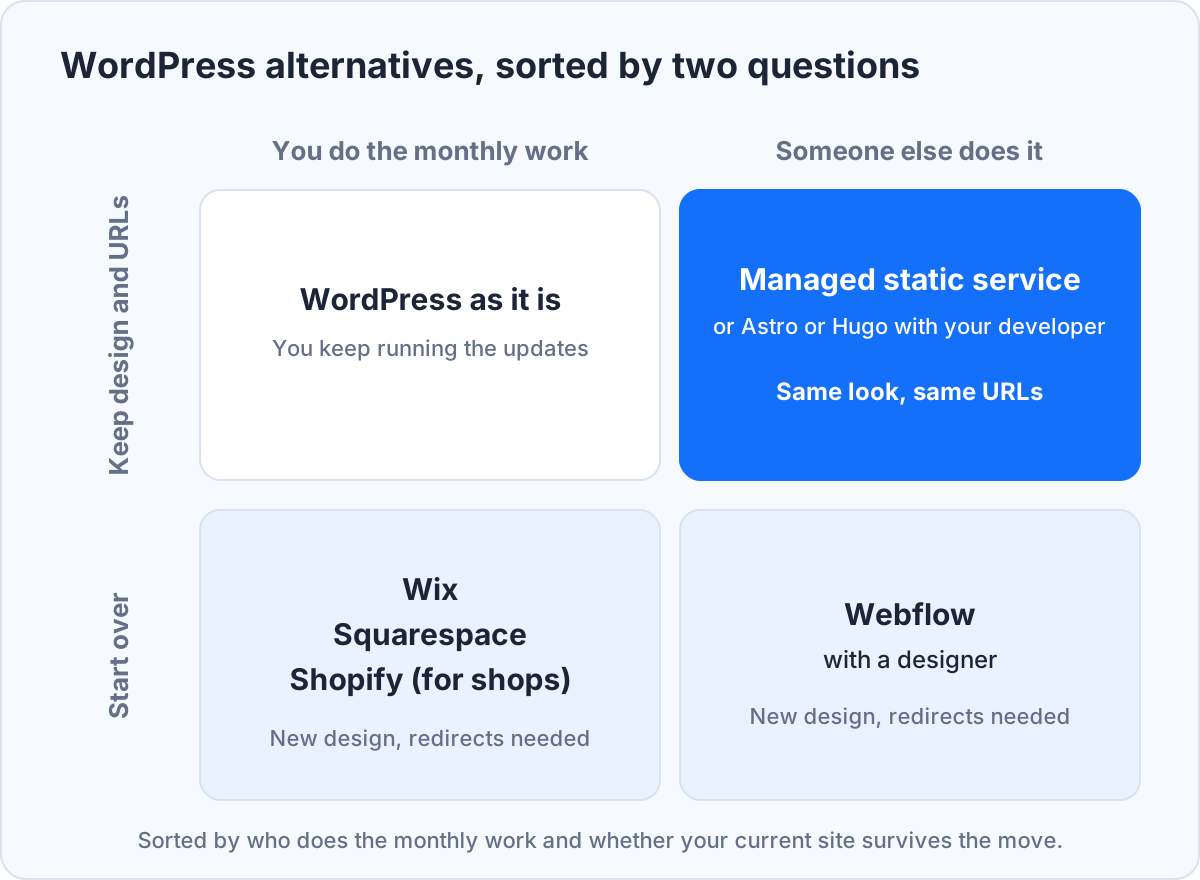
- Starting fresh and happy to edit yourself: Wix or Squarespace.
- Selling products online: Shopify.
- A designer on the team: Webflow.
- Keeping your site, with a developer: Astro or Hugo.
- Keeping your site, without a developer: a managed static service.
The short answer is that the platform matters less than who presses Update. Whichever route you pick, put the monthly running cost next to the build cost; our guide to website design costs in South Africa sets both out in rand.
Your site, minus the WordPress chores
We rebuild it as it is, check every page against the original, then you change it by email.
Show me how it worksChange your website by sending an email
We rebuild your WordPress site to load fast, then you email changes and approve every one before it goes live. R1 500 a month for the first 6 months, then R750 a month.